Quick Recipe Finder is a participant in the Amazon Services LLC Associates Program. If you buy through links on this page we may earn a commission, at no extra cost to you. Cooking times are guidance and vary by appliance. Always confirm doneness with a thermometer against USDA safe minimum internal temperatures.
Heavy cream holds a pasta sauce together because its fat content is high enough to resist splitting when it hits a hot pan, a splash of wine, or a spoonful of tomato. Swap in something with less fat or more protein and the physics change, sometimes fast. This guide ranks the common substitutes by how they actually behave under heat and acid, not just how close they taste.
Quick answer: Mascarpone or cream cheese thinned with milk hold up best, full-fat coconut cream is the top dairy-free option, and plain milk or low-fat yogurt split the easiest. Fat percentage, not flavor, predicts stability. For anything under 20% fat, add a cornstarch slurry before it meets heat or acid.
| Substitute | Fat % | Splits under direct heat? | Splits with acid (wine, tomato, lemon)? | Ratio for 1 cup heavy cream |
|---|---|---|---|---|
| Heavy cream (baseline) | 36-40% | Rare, even at a hard simmer | Rare | 1 cup |
| Mascarpone + milk | Blends to roughly 25-30% | Low risk | Low risk if added off direct high heat | 1/2 cup mascarpone whisked with 1/2 cup milk |
| Cream cheese + milk | Blends to roughly 20-25% | Low to moderate | Moderate, whisk constantly | 4 oz cream cheese whisked with 3/4 cup milk |
| Full-fat coconut cream | 20-22% | Low to moderate | Moderate, worse in very acidic sauces | 1 cup, chilled solids only |
| Cashew cream (homemade) | Effective 15-20% depending on water ratio | Moderate | Moderate | 1 cup soaked and blended cashews with water |
| Evaporated whole milk | 7-8% | Moderate to high | High, needs a starch buffer | 1 cup |
| Half-and-half + cornstarch | 10-12% | Moderate with starch, high without | Moderate with starch, high without | 1 cup half-and-half plus 1 tsp cornstarch slurry |
| Whole milk + butter | Roughly 10-12% | Moderate | Moderate to high | 3/4 cup whole milk whisked with 1/4 cup melted butter |
| Plain whole milk | 3-4% | High | High | 1 cup, add a starch buffer or expect thin sauce |
| Greek yogurt (full-fat) | 5-10% | High unless tempered | Very high unless tempered and off heat | 1 cup, thin with a few tbsp pasta water before adding |
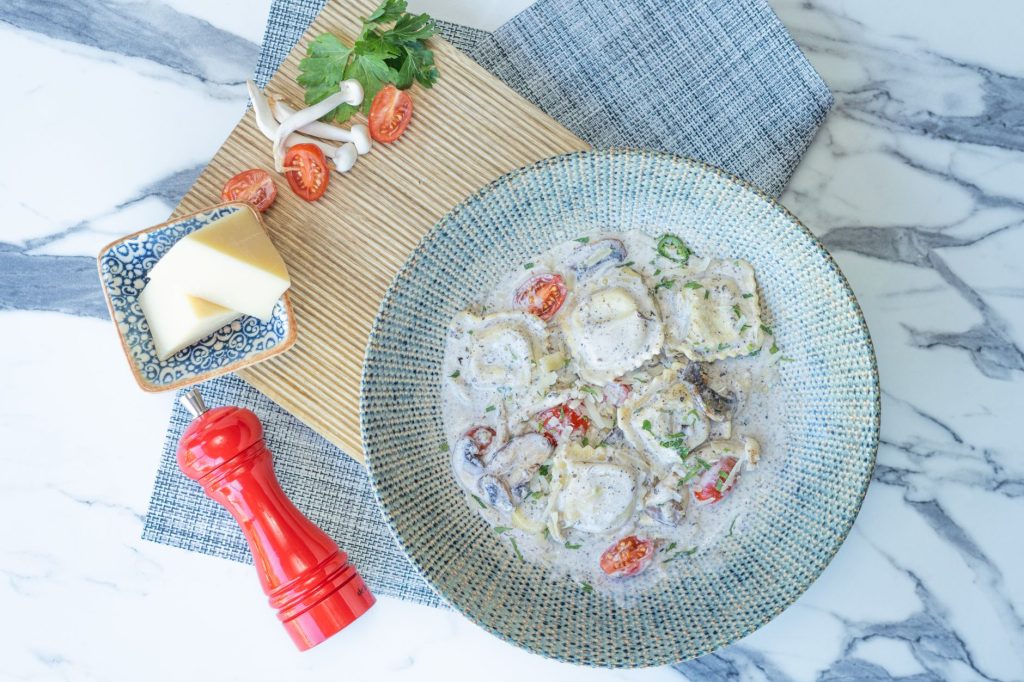
Ranking heavy cream substitutes for pasta by split risk
Fat is the stabilizer in a cream sauce. Fat globules coat and separate the proteins and water in milk, which is what keeps a sauce silky instead of grainy. Drop below roughly 20% fat and the margin for error shrinks fast, especially once acid or a hard boil enters the picture.
Low risk: mascarpone, cream cheese, full-fat coconut cream
These sit closest to heavy cream’s fat percentage once thinned to a pourable consistency, so they tolerate a simmer and a splash of wine reasonably well. Coconut cream is the standard dairy-free pick for this reason. If you are already working dairy-free in the kitchen, our dairy free milk substitute guide covers which plant milks hold up in savory cooking versus baking, and the dairy free butter substitute matrix is useful if a recipe also calls for butter in the same pan.
Moderate risk: cashew cream, evaporated milk, half-and-half with starch
These can make a fine sauce but they need help. A cornstarch or flour slurry whisked in before the dairy hits heat gives the proteins something to bind to instead of curdling on their own. Without that buffer, expect a sauce that looks fine off heat and breaks the moment it returns to a simmer.
High risk: plain milk, low-fat yogurt, skim-based products
Below about 10% fat, the sauce is relying almost entirely on starch or technique to stay smooth. These work as a last resort or in a sauce that is mostly starch-thickened already, like a simple butter and parmesan toss, but they are not a direct drop-in for a cream-forward sauce like alfredo or vodka sauce.
What changes the number
- Brand and fat labeling. Coconut cream and cashew cream concentration vary by brand and by how much liquid separates in the can, so check the label rather than assuming a flat percentage.
- Heat intensity. A gentle simmer is far more forgiving than a rolling boil. Lower substitutes benefit from the lowest heat that still keeps the sauce moving.
- Acid timing. Adding wine or tomato to the pan before the dairy, and letting it reduce slightly, is gentler than adding dairy and acid at the same moment.
- Pan material and residual heat. A heavy pan holds heat after you pull it off the burner, which can still break a marginal sauce even with the flame off.
- How long it simmers. A sauce that sits at heat for ten minutes has more opportunity to split than one finished in two or three. This is guidance, not a fixed rule, and depends on your specific stove and pan.
Common mistakes with a heavy cream substitute for pasta
- Adding cold dairy straight into a hard-boiling sauce instead of tempering it in gradually with a ladle of the hot liquid first.
- Using a low-fat substitute in a recipe written for heavy cream without adding a starch buffer to compensate.
- Adding lemon juice, wine, or tomato directly to a lower-fat dairy substitute at full heat instead of off heat or at a bare simmer.
- Boiling a finished cream sauce to reduce it, which concentrates both the fat and the risk of breaking it.
- Assuming all canned coconut products behave the same way. Coconut milk and coconut cream have different fat loads and the thinner one splits more easily.
How to fix a broken cream sauce
If the sauce has already separated into greasy pools or grainy curds, it is often recoverable. Pull the pan off the heat first, since more heat makes it worse.
- Remove the pan from direct heat entirely.
- Whisk in a splash of cold pasta water or cold milk, a tablespoon at a time, to shock the emulsion back together.
- Whisk vigorously and consistently rather than stirring. An immersion blender can re-emulsify a broken sauce faster and more evenly than a whisk if whisking alone is not pulling it back together.
- If the sauce is thin after it comes back together, stir in a small cornstarch slurry (about one teaspoon cornstarch to one tablespoon cold water per cup of sauce) and return to the very lowest heat just until it thickens slightly.
- If it still will not come back, strain out any solid curds, reserve the liquid fat and starch, and build a fresh small batch of sauce with that liquid as the base rather than starting over completely.
A small immersion blender is worth having on hand for exactly this kind of save, and it is useful well beyond pasta sauce for soups and dressings too.
See immersion blender options on Amazon
FAQ
Can I use milk instead of heavy cream for pasta?
Plain milk works in a pinch but it has roughly a tenth of the fat of heavy cream, so the sauce will be thinner and more prone to splitting, especially with acid. Add a cornstarch slurry and keep the heat low to compensate, or use a milk and butter blend for more fat.
What is the best dairy free heavy cream substitute for pasta?
Full-fat coconut cream, using only the solid portion from a chilled can, is the closest dairy-free match for fat percentage and sits closest to heavy cream on split risk. Cashew cream is a milder-flavored second option but needs a starch buffer in most sauces.
Does half and half split in pasta sauce?
It can, since it sits around 10-12% fat compared to heavy cream’s 36-40%. It holds up reasonably well at a gentle simmer but benefits from a small cornstarch slurry if the sauce includes wine, tomato, or lemon.
Can cornstarch fix a broken cream sauce?
Yes, a cornstarch slurry whisked into a sauce after it has been pulled off heat and partially re-emulsified with cold liquid can help it hold together and thicken back up. Cornstarch does not undo curdled proteins on its own, so re-emulsify first, then thicken.
Practical recommendation
For a direct stand-in with the least risk, reach for mascarpone or cream cheese thinned with a little milk, or full-fat coconut cream for a dairy-free version. If you only have a lower-fat option like evaporated milk or half-and-half, add a cornstarch slurry before the dairy meets heat or acid, keep the sauce at a bare simmer, and add any wine or tomato in stages rather than all at once. If a swap elsewhere in the recipe is also on your mind, the dairy free milk substitute guide and dairy free butter substitute matrix cover the rest of a fully dairy-free pasta night.