Quick Recipe Finder is a participant in the Amazon Services LLC Associates Program. If you buy through links on this page we may earn a commission, at no extra cost to you. Cooking times are guidance and vary by appliance. Always confirm doneness with a thermometer against USDA safe minimum internal temperatures.
Eggs do four different jobs in baked goods: they bind ingredients together, they help leaven, they add moisture, and they add richness and structure through fat and protein. A vegan egg substitute that nails one job often fails at another, which is why a single all-purpose swap does not exist. Picking the right one starts with naming the job the egg was doing in that specific recipe.
Quick answer: Match the substitute to the job. Use ground flax or chia (1 tbsp plus 3 tbsp water per egg) for binding, baking soda plus vinegar for leavening, applesauce or mashed banana (1/4 cup per egg) for moisture, and silken tofu or commercial egg replacer for richness in dense bakes.
| Job | Best Substitute | Ratio Per Egg | Works Best In |
|---|---|---|---|
| Binding | Flaxseed meal + water | 1 tbsp meal + 3 tbsp water, rested 5 min | Cookies, quick breads, muffins |
| Binding | Chia seed + water | 1 tbsp whole or ground chia + 3 tbsp water, rested 10 min | Denser cookies, bars |
| Leavening | Baking soda + vinegar | 1 tsp soda + 1 tbsp vinegar (cider or white) | Cakes, cupcakes needing lift |
| Leavening | Commercial egg replacer (starch-based) | Per package, roughly 1.5 tbsp powder + 3 tbsp water | Cakes, waffles, pancakes |
| Moisture | Unsweetened applesauce | 1/4 cup (60 ml) per egg | Muffins, quick breads, brownies |
| Moisture | Mashed ripe banana | 1/4 cup (60 g) per egg | Muffins, pancakes (adds flavor) |
| Richness | Silken tofu, blended smooth | 1/4 cup (60 g) per egg | Dense cakes, brownies, custard-style bars |
| Richness | Vegan yogurt | 1/4 cup (60 g) per egg | Cakes, muffins wanting tenderness |
| All-purpose / foaming | Aquafaba (chickpea liquid) | 3 tbsp per egg, or whip to soft peaks for meringue-style bakes | Meringues, macarons, mousses, some cakes |
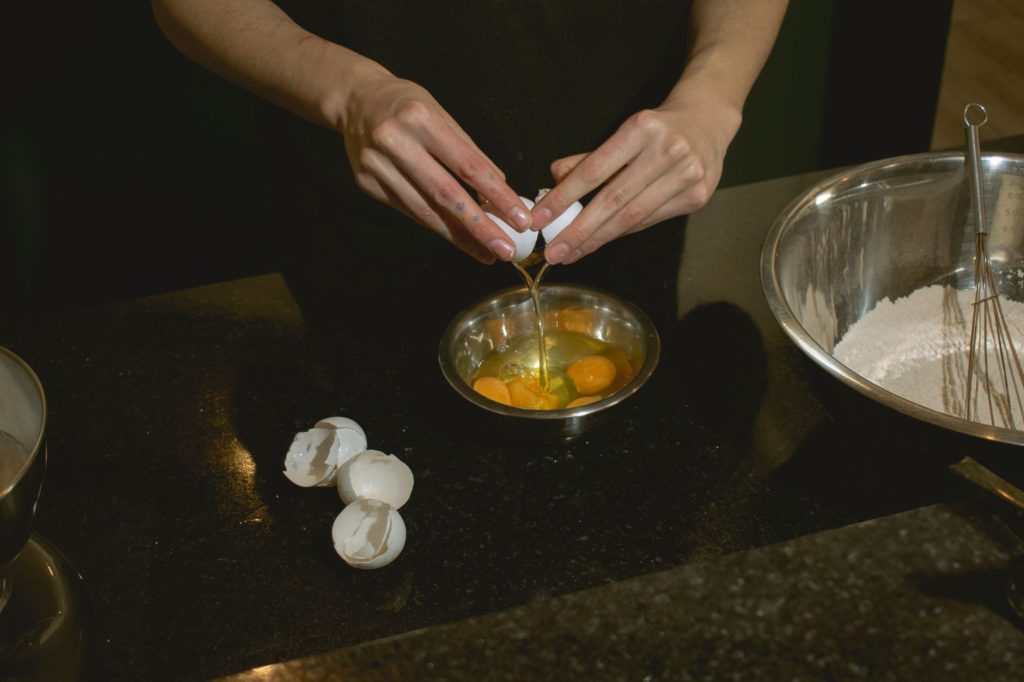
How to pick the right egg substitute in baking vegan recipes
Start by asking what the egg was doing before you swap it. A recipe with a full cup of butter and only one egg is probably leaning on that egg for moisture or a small binding assist, not structure. A sponge cake with three eggs and almost no other liquid is leaning on eggs for leavening and structure, and that recipe is harder to convert cleanly.
Binding: hold the dough or batter together
Flax and chia eggs work by forming a gel when the ground seed meets water. That gel mimics the way egg proteins trap moisture and hold crumb together, which is why they perform well in cookies and quick breads where you want the dough to hold shape but do not need much rise. Let the mixture sit for the full rest time before adding it to the batter, since an under-rested flax egg is thin and will not bind the same way.
Leavening: help the bake rise
Baking soda and vinegar create a quick carbon dioxide reaction, similar in effect to whipped egg foam but faster and less stable. It works well in cakes and quick breads that already have a reasonable amount of baking powder for backup lift. Commercial starch-based egg replacers (often potato starch or tapioca starch blends) are formulated specifically for this job and tend to be more predictable across recipe types, which is worth it if you bake vegan often enough to keep a box on hand.
Moisture: keep the crumb from drying out
Applesauce and mashed banana both add water bound up in fruit pectin and sugar, which keeps a crumb soft. Applesauce is closer to neutral in flavor; banana adds its own taste, so save it for recipes where that flavor is welcome. Neither one adds meaningful binding or leavening power, so a recipe that needs eggs for structure will still come out fragile if this is your only swap.
Richness: replace the fat and protein contribution
Silken tofu, blended until smooth with no visible lumps, adds protein and a custard-like richness that works well in dense cakes and brownies. Vegan yogurt does something similar with a bit more tang and tenderness. For a related swap, see our yogurt substitute dairy free matrix by job if the recipe is already dairy-free and you are deciding what kind of yogurt to use.
The failure table: what goes wrong and why
Vegan baking failures usually show up in one of three places: the crumb, how much the bake spreads, or how it browns. Here is what each symptom usually points back to.
| Symptom | Likely Cause | Fix to Try |
|---|---|---|
| Dense, gummy crumb | Too much liquid-based substitute (applesauce, banana) with no binding help | Pair a moisture substitute with a flax or chia egg for structure, especially with more than one egg replaced |
| Cookies spread flat and thin | Flax or chia egg was under-rested and stayed too liquid | Rest the full 5 to 10 minutes until it visibly thickens to a gel before mixing in |
| Cake does not rise | Relied on baking soda and vinegar alone in a recipe that needed real structural lift from eggs | Add extra baking powder (roughly 1/2 tsp per egg replaced) or switch to a starch-based commercial replacer |
| Crumbly, falls apart when sliced | No binding substitute used at all, only a moisture swap | Add 1 tbsp flax meal + 3 tbsp water per missing egg alongside the moisture swap |
| Pale, underbrowned crust | Egg proteins normally contribute to browning through the Maillard reaction, and most substitutes lack that protein | Brush the top with a milk-based wash before baking; see the egg wash substitute guide below |
| Gummy or wet center in a thick bake | Tofu or yogurt substitute used at full ratio in a recipe already high in liquid | Reduce other liquid in the recipe by 2 to 3 tbsp per substitute egg, or bake slightly longer and confirm with a toothpick |
What changes the exact ratio
These numbers are starting points, not guarantees, because a few variables shift how much substitute a given recipe actually needs.
- How many eggs are being replaced. Swapping one egg in a four-egg cake is low risk. Swapping all four at once compounds any mismatch in binding, leavening and moisture, so the failure modes above become more likely as the egg count goes up.
- Batter thickness. A thick cookie dough tolerates a wetter substitute better than a thin cake batter, which can turn gummy fast if extra liquid is added on top of an already loose batter.
- Fat content already in the recipe. Recipes already high in oil or vegan butter need less richness from the egg substitute, so tofu or yogurt swaps can sometimes be scaled back slightly.
- Oven and pan behavior. Oven performance varies by model, and darker pans brown faster than light ones, so treat any bake time as a range and confirm doneness with a toothpick or cake tester rather than the clock alone.
- Brand of commercial egg replacer. Starch-based replacers vary in exact ratio by brand, so check the package rather than assuming every one behaves the same as flax or chia.
A kitchen scale removes a lot of the guesswork here, since “1/4 cup mashed banana” can vary a fair amount by how tightly it is packed, while weighing it in grams stays consistent every time. A basic digital kitchen scale is worth having on hand if you bake vegan substitutes regularly.
Common mistakes
- Using a moisture substitute where the recipe needed binding. Applesauce and banana do not hold crumb together the way flax or chia gel does, so a cookie recipe with only an applesauce swap often falls apart.
- Skipping the rest time on flax and chia eggs. The gel takes a few minutes to form. Adding it to the batter too early means adding liquid, not a binder.
- Replacing more than two eggs with the same single substitute. Recipes with three or more eggs usually need a combination, for example one flax egg for binding plus a starch-based replacer for lift, rather than tripling one substitute.
- Forgetting the browning gap. Since most egg substitutes lack the protein that drives browning, a pale top is not necessarily underbaked. Confirm doneness with a toothpick or thermometer rather than color alone, and see our egg wash substitute finish matrix for browning fixes by bake type.
- Not adjusting other liquids. If the substitute itself is liquid-heavy (applesauce, banana, aquafaba), the recipe’s other liquid may need a small reduction to avoid a wet crumb.
FAQ
What is the best egg substitute for baking cookies vegan?
A flax egg (1 tbsp ground flaxseed plus 3 tbsp water, rested until gelled) is generally the most reliable choice for cookies because it prioritizes binding, which is the job cookies need most from an egg.
Can I use aquafaba instead of eggs in every recipe?
Aquafaba, the liquid from a can of chickpeas, whips up similarly to egg whites and works well in meringues and mousses. For dense cakes or anything needing strong binding, it is usually weaker than flax or a commercial replacer, so treat it as a specialty tool rather than a universal swap.
How many flax eggs equal one real egg?
One flax egg (1 tbsp ground flaxseed meal plus 3 tbsp water, rested 5 to 10 minutes until it thickens to a gel) is generally treated as equivalent to one whole egg for binding purposes in most quick breads, muffins and cookies.
Why did my vegan cake sink in the middle?
This usually points to a leavening mismatch, meaning the substitute used (often a moisture-only swap like applesauce) did not provide the lift the eggs normally would. Adding a bit of extra baking powder or switching to a starch-based commercial egg replacer for that recipe is the usual fix.
Practical recommendation
Before reaching for any substitute, decide what job the egg was doing in that specific recipe: binding, leavening, moisture, or richness. Match the substitute to that job using the table above, rest flax or chia eggs fully before mixing, and expect a slightly paler top since most substitutes skip the browning that egg protein provides. If the recipe already leans on dairy substitutes, check our dairy-free butter substitute swap matrix and dairy-free milk substitute guide so every swap in the batter is working toward the same texture instead of against it.